The Jackal
The Day of the JackalThe Jackal is the foreign-born English assassin hired by Marc Rodin to kill Charles de Gaulle, and the novel’s central embodiment of professional violence joined to meticulous self-invention. He moves through the plot less as a stable public identity than as a sequence of researched names, documents, clothes, and appearances. Even when the conspiracy is exposed, he retains the advantage of a legitimate passport and several additional disguises; his struggle with Claude Lebel is therefore also a contest over whether he can remain unrecognizable long enough to reach his target.
Identity and Introduction
The Jackal first appears as a tall, blond Englishman returning from two months in Lebanon. He is tanned, relaxed, and physically fit, and his journey is linked not only to the pleasures of the region but to supervising the transfer of a substantial sum from a bank in Beirut to another in Switzerland. The money movement introduces a practical dimension to his character: travel, finance, and preparation are already parts of the same professional life.
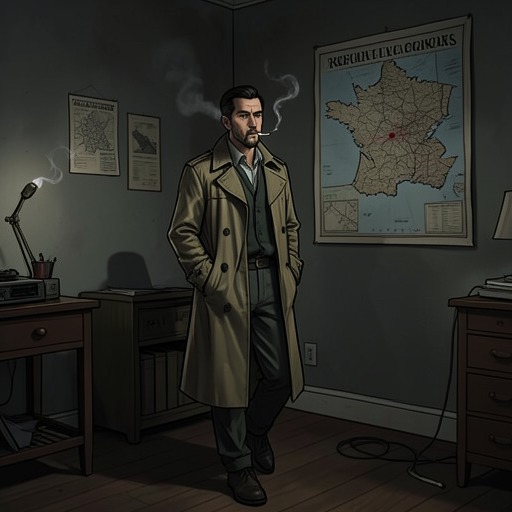
When he meets Marc Rodin, his controlled appearance seems to confirm the impression of a man who governs himself. Rodin judges him to be about six feet tall, in his early thirties, lean and athletic, with regular but unremarkable features and hands resting quietly on the chair. What unsettles Rodin is the Englishman’s gaze: grey, flecked eyes that appear open and candid but reveal no expression. The contrast between apparent frankness and unreadability becomes an emblem of his method. He can present a face without making it a reliable guide to the person behind it.
The Jackal does not approach the OAS as a political believer. He tells its leaders that they are hunted while he is free to move without surveillance, and distinguishes their idealism from his work for money. He has learned that they are making enquiries about him and explains that he investigated their organisation in the British Museum’s French newspaper files. His frankness is itself a form of control: by naming the professional arrangement openly, he refuses the ritual of concealment and establishes himself as an informed negotiator rather than a supplicant.
Rodin eventually asks whether he will assassinate Charles de Gaulle. The Jackal’s blank gaze returns, and Rodin raises the question of what name he should use if he wishes to remain anonymous. The chosen codename, The Jackal, gives the operation a public label while leaving the man himself obscured. Later, the French authorities connect that name to the blond foreign killer whom Rodin and the other OAS chiefs had met at Pension Kleist in Vienna. The codename first functions as a clue for investigators, but it never becomes a personal history that explains or humanises its bearer.
Research and the Construction of Identity
After returning to London, The Jackal spends the last fortnight of June and the first two weeks of July in controlled preparation. He sets himself to read nearly everything written about or by Charles de Gaulle. A library reference to the French President in the Encyclopaedia Britannica leads him to a list of further books. The research is practical rather than incidental: he is studying the person whose habits and public appearances will determine the conditions of the assassination.
He also decides to conduct the operation under a false identity. To create a British passport identity, he searches small villages in the Thames Valley for a suitable gravestone. In the third cemetery he finds the name Alexander Duggan, a child who died aged two and a half in 1931. The child, had he lived, would have been only a few months older than the assassin. The Jackal presents himself to the elderly vicar as an amateur genealogist, turning a dead child’s record into the starting point for a usable adult identity.
The identity he constructs is Alexander James Quentin Duggan, born on April 3, 1929, in the parish of St Mark’s, Sambourne Fishley. He applies for a passport through the normal process on July 14, 1963; it is issued the following day and mailed on July 17 to the address on his application, which the police suspect is an accommodation address. The ordinariness of the procedure matters. The false identity is not merely a disguise to be worn at a checkpoint: it is supported by an official document obtained in a way that initially resembles legitimate administration.
His supporting cards extend that fabrication into everyday life. One driving licence states that Alexander James Quentin Duggan of London W1 may drive specified vehicle groups from December 10, 1960, through December 9, 1963. Other cards bear photographs taken at different times. Skilled retouching changes the apparent shirt and adds stubble to one portrait, making the images resemble separate photographs of the same man rather than reproductions of a single sitting. Their excellent draughtsmanship gives the deception a mundane, bureaucratic texture: the papers are designed to withstand the small comparisons by which identity is ordinarily accepted.
Multiple Disguises and a Changing Trail
Duggan is only the most secure layer of The Jackal’s assumed identity. When the investigation is blown, he understands that the authorities do not know what he knows: he is travelling under a legitimate passport in an assumed name and has three further sets of false papers, including two foreign passports, with matching disguises. The distinction between the valid passport and the additional false documents gives him options after the original cover becomes dangerous. His planning treats exposure not as an impossible failure but as a condition for which he has prepared alternatives.
The police reconstruct his route through fragments of travel information. Duggan spends only five hours in Brussels, arriving from London on a BEA flight and leaving that afternoon for Milan on Alitalia. He pays cash for the ticket, although it had been booked by telephone from London several days earlier. A routine report then places Alexander James Quentin Duggan among those entering France from Italy at Ventimiglia. The sequence shows how a seemingly small administrative trace can become significant once investigators have a name to follow—and how cash, advance arrangements, and brief stays complicate that trail without erasing it.
His disguises are complete changes of social presentation, not simply new names. In one stage he packs the rifle parts with the army greatcoat and soiled clothing of the fictitious Frenchman Andre Martin, checking that the papers in the lining have not been disturbed. In another, he leaves that suitcase in the left-luggage office at Gare d’Austerlitz and keeps the case containing the clothes and papers of Marty Schulberg, an American student from Syracuse, New York. He removes grey dye, restores the blond hair, recolours it chestnut brown, keeps blue contact lenses, exchanges gold-rimmed glasses for heavy-rimmed spectacles, and changes clerical clothes for sneakers, jeans, a T-shirt, and a windcheater. The transformation is accomplished through the coordination of hair, eyes, clothing, documents, luggage, and destination.
For the final approach represented in the evidence, he lays out the clothing of Andre Martin: scuffed black shoes, grey woollen socks, trousers, an open-necked shirt, a long military greatcoat bearing campaign ribbons, and a black beret. Forged papers complete the veteran’s identity. The collection is arranged in a bedroom before it is worn, making the disguise appear as a prepared uniform for entering the guarded public scene. His repeated changes also help explain why Claude Lebel imagines the assassin as someone who has stayed outside official police files by working under false names and appearances.
Exposure and the Decision to Continue
The first decisive breach in the Jackal’s anonymity comes through Viktor Kowalski’s dying testimony. Colonel Rolland had initially treated the repeatedly crossed-out word “jackal” as an insult used by the tortured man. Once its meaning is recognised as a codename, the word identifies the foreign blond killer and links him to the OAS chiefs’ meeting in Vienna. Rolland also deduces why a wave of bank and jeweller robberies has shaken France: the OAS needs money for the assassination, not for an ordinary criminal dispute.
A call from a post office near Gare du Nord makes the exposure unmistakable. An operator monitoring the Rome hotel where the OAS leaders are staying hears the message from Valmy to Poitiers: “The jackal is blown. Repeat. The Jackal is blown. Kowalski was taken. Sang before dying. Ends.” The terse transmission converts private suspicion into a warning that the conspiracy is no longer secret. The authorities, meanwhile, recognise that Kowalski is dead and that he told them what little he knew; only four men are believed to know the assassin’s identity, The Jackal among them and the other three in Rome.
The Jackal receives advice to quit and go home, but the warning does not end his journey. Valmy has admitted that he lacks direct authority from Rodin to cancel the operation. The Jackal’s response is shaped by what the breach reveals to him about the OAS: he already distrusts its security, and the message confirms that distrust. Yet he also knows that the police cannot identify his remaining papers and disguises. After taking stock, he pays the bill, leaves a large tip, and drives away from the Majestic into the heart of France. The choice to proceed is neither a belief that the plot remains secret nor confidence in his employers; it rests on his own contingency planning.
Pursuit and Narrative Significance
Claude Lebel tries to imagine the man concealed by the Duggan photographs: someone dangerous, meticulous, and experienced, yet absent from official police files. The photographs prompt him to consider how one person could become another through changes of height, hair, eyes, age, and manner. Lebel’s questions about weapons and access to the President’s security perimeter also expose the practical difficulty that separates the assassin’s preparation from the final act. The Jackal is formidable not because the police can already see his whole plan, but because they must infer it from incomplete records while he continues to alter the evidence of who he is.
The repeated telephone greeting “Ici Chacal” gives his codename a second function. It is not only the name by which the authorities pursue him; it is also the controlled signal through which he maintains contact. Against it, the investigation assembles passport dates, photographs, bookings, border reports, and the testimony extracted from Kowalski. The contrast is structural: The Jackal attempts to make each trace compatible with a different person, while Lebel’s work is to connect those traces into one moving target.
At the point where the supplied scenes culminate, the disguise of Andre Martin places The Jackal near the public ceremony, rifle ready and sight fixed on the head of the veteran nearest to the forecourt. From six floors up and 130 metres away, he watches Charles de Gaulle’s raised hand come down from the peak of the kepi and aligns the telescopic sight with the exposed temple. The sequence narrows the novel’s contest to a single line of sight, but it does not end with the shot: the final exchange represented here is between The Jackal and Claude Lebel, who identify themselves simply as “Chacal” and “Lebel.” The assassin’s elaborate substitutions have brought him to that face-to-face confrontation, where the man who has spent the story controlling how he is seen can no longer remain only a name in a report.